
Contract intelligence for executives
When something happens, ask every contract what it means.
A rate moves, a supplier is acquired, a regulation lands. Aavenir Atlas reads the signed portfolio, answers with the clauses cited and ranked by value, and suggests the next best question and the next best action for a person to approve.
Our customers
Procurement, legal, IT, finance, and sales teams run their contracts on Aavenir.






Definition
What is contract intelligence for executives?
Contract intelligence for executives is the ability to ask a business question of every signed agreement at once, such as what an index move costs or which suppliers must consent to an acquisition, and get a cited answer.
Dashboards show what someone decided to track last year. Executive questions arrive with an event attached, and the answer usually sits in a clause nobody extracted: an escalation right, a consent requirement, a termination for convenience, an audit right. Aavenir Atlas reads masters, amendments and related agreements together, so the answer reflects the terms actually in force.
- Plain language questions across the whole portfolio, answered with citations
- Results ranked by contract value, so the first page is the one that matters
- A suggested next best question narrows the answer to a decision
- A proposed next best action goes to a named owner for approval
- Atlas is in early access, by invitation, on a sample of your own agreements
Four seats, four questions
The question each executive brings to the portfolio.
Demo questions of the kind design partners ask. Each answer comes back as a list of agreements and clauses, not a summary.
What can our suppliers charge us next year?
Escalation clauses, index references and caps across every supplier agreement, with the notice each supplier must give. Price escalation rights. Caps in amendments. Payment term exposure.
What are we entitled to that we never collected?
Rebates, volume tiers, service credits and price protections the contracts grant, ranked by supplier spend. Rebates and tiers. Service credits. Price protections.
What breaks if we sell this business unit?
Consent, notice and termination terms triggered by a change of control or assignment, cited clause by clause. Consent to assign. Termination rights. Uncapped liability.
Which critical vendors could we not exit cleanly?
Exit plans, data return terms, audit rights and termination notice across technology and ICT agreements. Exit and transition. Data return. Audit rights.
The board question
How a portfolio question gets answered today, and with Atlas.
Today
- ×The question goes to legal and procurement as an email
- ×Someone samples the twenty largest contracts and reads them
- ×Amendments that changed the original terms get missed
- ×The answer comes back as a slide two weeks later
- ×Nobody owns the follow-up, so the right lapses
With Atlas
- The question goes to Atlas in plain language
- Every agreement loaded is read, not a sample
- Masters and amendments are read together for the terms in force
- The answer arrives ranked by value, with each clause cited
- A next best action is proposed to a named owner for approval
How it works
Ask, rank, decide, then act.



-
Plain language, no query builder or report request Masters, statements of work and amendments read together Every answer links to the clause a reader can open.
-
Results sorted by contract value, not by file name Each line states the right and the condition attached Agreements with no right are listed too, so nothing is assumed.
-
Atlas suggests the follow up a specialist would ask Each suggestion narrows the answer toward a decision Executives decide which thread to pull.
-
A proposed action with the clause, the deadline and the owner Nothing is sent or changed until a person approves it The decision is logged next to the answer that prompted it.
Watch
See it in the product.
 15:50
Why it matters
The cost of contracts nobody reads, measured.
Customer stories
Results from the contract foundation Atlas reads
 Southeast Asian bank
A leading Southeast Asian bank cut its approval cycle fivefold
 Mining company
A mining company connected sourcing to contracting
 Fortune 500 insurer
A Fortune 500 insurer cut its contract cycle by 70%
Breakthrough results for our legal team.
Aavenir and the alternatives
How Aavenir compares with the other ways teams do this.
| What matters | Aavenir | Standalone contract lifecycle management tools | Shared drives, email and spreadsheets |
|---|---|---|---|
| Where it runs | Native on ServiceNow, or deployed standalone | Their own platform, connected to other systems by integration | Wherever the file was last saved |
| One record across the lifecycle | Sourcing, contract, obligations and invoices on one record | Usually the contract stage, other stages through partners | No record, only files and threads |
| AI at each stage | Aavenir AI extracts terms, reviews against your playbook and tracks obligations, and a person approves | Varies by product, often strongest in review and search | None |
| After signature | Obligations assigned, evidence checked, renewals flagged before the notice window | Varies by product | A calendar reminder, if someone set one |
| Where others can be stronger | Configured to your workflow, one module or the whole suite | Often a quick start for a single legal team | Free and familiar, until volume grows |
Comparisons describe categories of tools, not named products. For named comparisons, see Aavenir compared.
Further reading
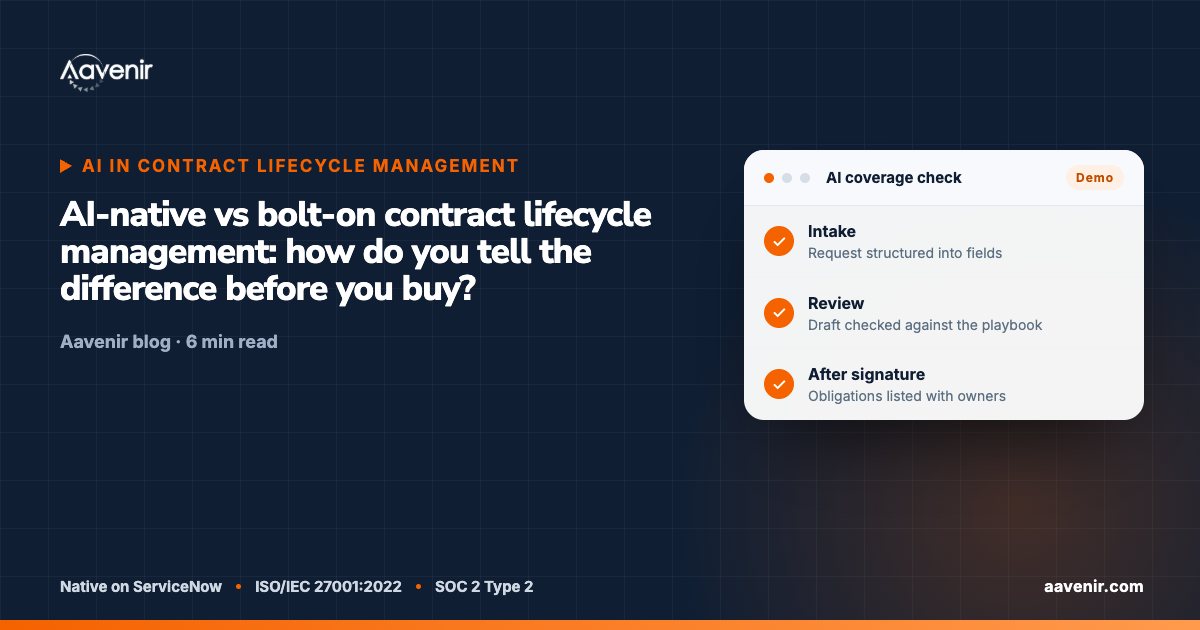 AI in contract lifecycle management AI-native vs bolt-on contract lifecycle management: how to tell the difference before you buy Read the article
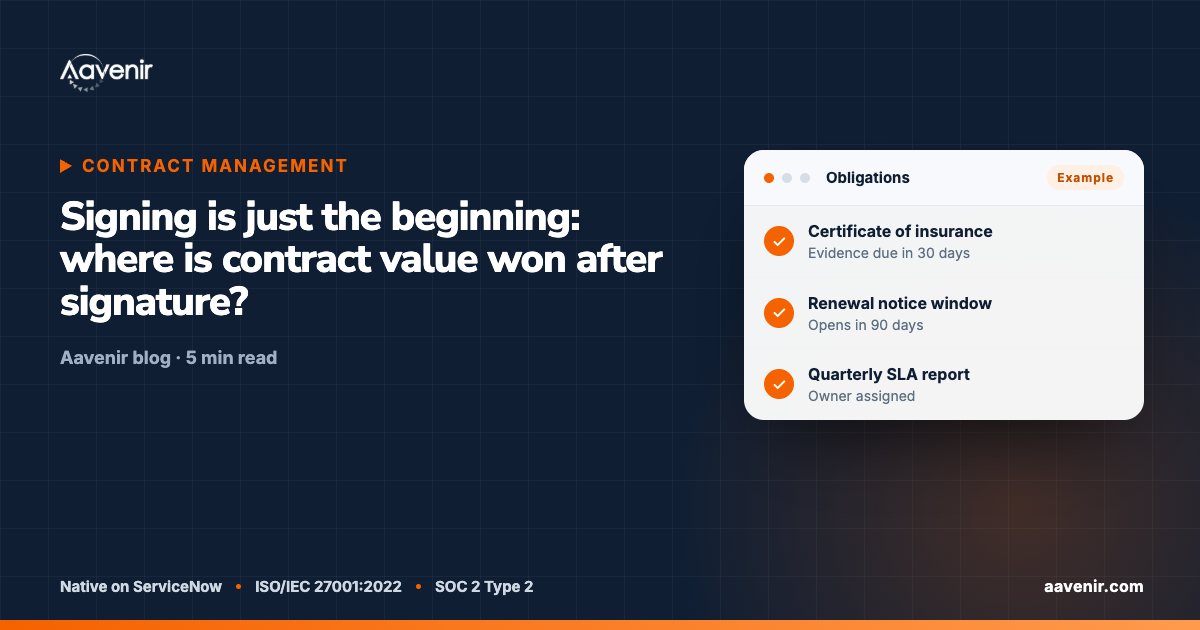 Contract management Where contract value goes after signature Read the article
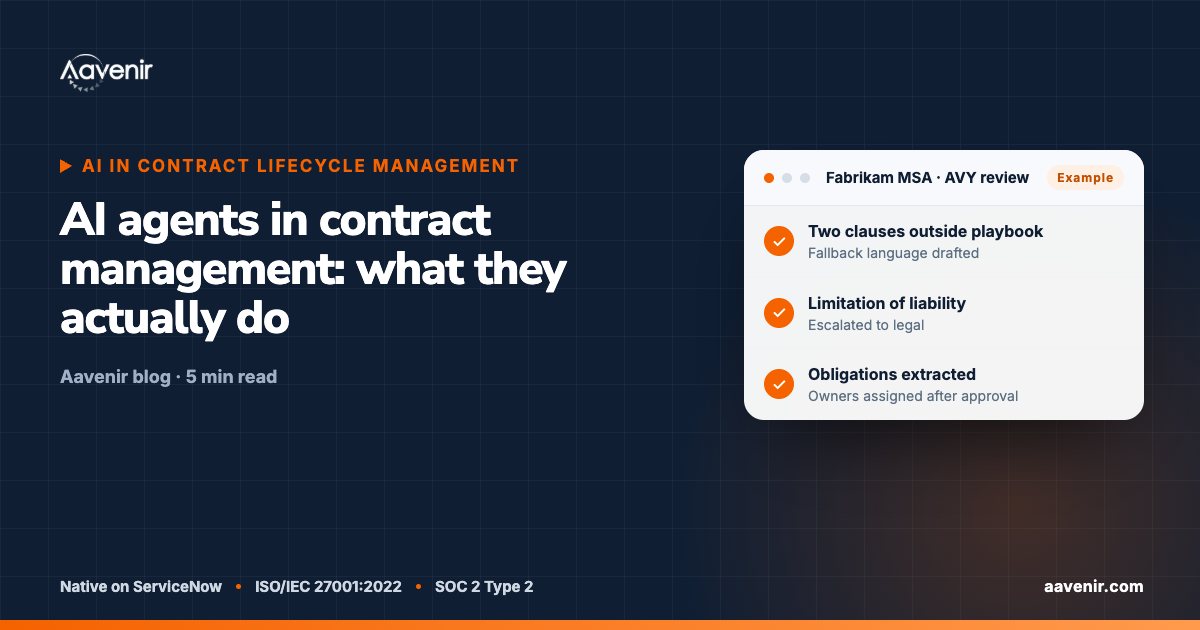 AI in contract lifecycle management AI agents in contract management: what they actually do Read the article
Questions
Talk to a contract expert
Bring a few sample agreements. We will show you Aavenir AI reading them, on ServiceNow or standalone.
Schedule a DemoQuestions worth asking next
Aavenir Atlas Contract intelligence, with early accessLearn more  Aavenir Intelligence Platform The AI behind every moduleLearn more Change of control review Which agreements need consent in a dealLearn more
 Supplier price increase review What the contract allows a supplier to chargeLearn more
 Service credit recovery Outages that earned credits nobody claimedLearn more
 Third party risk and DORA ICT contracts against the regulationLearn more
Frequently asked questions (FAQ)
Common questions
What is contract intelligence?
Contract intelligence is AI that reads a whole portfolio of signed agreements and answers business questions about them, such as which contracts allow a price increase or need consent in an acquisition, with each answer cited to the clause. Aavenir Atlas also ranks answers by value. Explore Atlas.
What do next best question and next best action mean in Atlas?
After each answer, Atlas suggests the follow up question a specialist would ask, so an executive can narrow from a list of contracts to a decision. It then proposes an action, with the clause, deadline and owner, which a person approves before anything happens. See how Atlas works.
Is Atlas available today?
Atlas is in early access, by invitation. Aavenir loads a sample of your signed agreements, your commercial, legal and finance teams ask Atlas their real questions for 14 days, and you keep the findings report, ranked by value with the clauses cited. Request early access.
How is Atlas different from a contract dashboard?
A dashboard shows fields someone chose to extract in advance. Atlas reads the agreements when the question is asked, including amendments and related documents, so it can answer questions nobody planned for, such as a consent check before an acquisition. See the AI behind it.
Have a question we have not answered? Ask the Expert
Schedule a demo
See your contracts run on one record.
- 1 A 30 minute walkthrough Built around your team, whether that is procurement, legal, IT or finance.
- 2 Your contracts, not ours Bring a few sample agreements and watch Aavenir AI extract and review them.
- 3 ServiceNow or standalone We show the deployment that fits the systems you already run.
Prefer to talk first? Contact the team.
The form did not load. Contact the team instead, or refresh the page.